

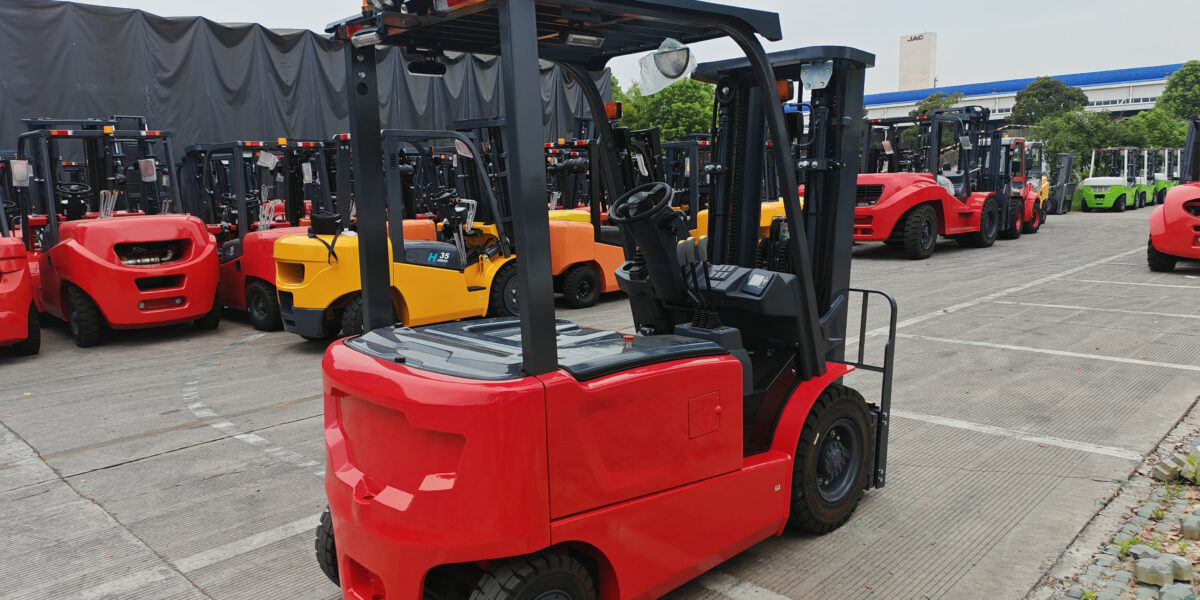
Many businesses considering a forklift purchase ask an important question: Can electric forklifts be used outdoors?The short answer is: Yes, electric forklifts can be used outdoors, but the right model and configuration must match the working environment.
Electric forklifts are traditionally associated with warehouses, factories, distribution centers, and other indoor applications. However, advances in battery technology, electric drive systems, vehicle protection, and outdoor-oriented configurations have made many electric counterbalance forklifts suitable for both indoor and outdoor material handling.
However, this does not mean that every electric forklift can simply be driven outside. The suitability of an electric forklift for outdoor operation depends on its configuration, terrain, weather conditions, tires, battery system, and required protection level.
1. Why Can Electric Forklifts Be Used Outdoors?
Electric forklifts use batteries and electric motors for power. Their power source does not automatically limit them to indoor applications.Instead, outdoor suitability depends on factors such as the vehicle’s protection level, tire type, ground clearance, chassis design, battery system, and ability to operate in different weather conditions.
For example, an appropriately configured electric forklift can handle pallet transportation, truck loading and unloading, and short-distance material handling on concrete floors, asphalt roads, and other relatively flat outdoor surfaces.
Compared with internal combustion forklifts, electric forklifts generally produce less operating noise and no tailpipe emissions. This makes them a practical option for businesses that need to move materials between indoor warehouses and outdoor loading areas.
2. What Type of Electric Forklift Is Suitable for Outdoor Use?
Not every electric forklift designed for warehouse applications is suitable for continuous outdoor operation.If your business requires frequent outdoor forklift work, several important factors should be considered.
2.1 Tire Type
Tires are one of the most important factors when determining whether an electric forklift is suitable for outdoor use.Indoor warehouses generally have smooth and level floors, while outdoor areas may contain uneven surfaces, small potholes, gravel, slopes, or other obstacles.
For outdoor applications, businesses may need to consider configurations such as solid tires or pneumatic tires, depending on the actual ground conditions.The tire should be selected according to the surface on which the forklift will operate. A tire configuration that works well on a smooth warehouse floor may not provide the same performance on uneven outdoor terrain.
2.2 Water and Dust Protection
Outdoor forklifts may be exposed to rain, dust, mud, snow, and other environmental conditions. Therefore, the protection of electrical components is particularly important.When selecting an electric forklift for outdoor use, buyers should check the vehicle’s IP rating, if applicable.
The IP code indicates the level of protection provided against solid particles and water. A suitable protection level can help determine whether the forklift is appropriate for the expected outdoor environment.
Therefore, when purchasing an outdoor electric forklift, businesses should consider more than lifting capacity and battery capacity. The vehicle’s protection specifications should also match the working conditions.
2.3 Operator Cab and Lighting
If a forklift needs to operate regularly in rain, snow, strong wind, or cold weather, an enclosed operator cab may be worth considering.For outdoor operations at night or in low-light areas, work lights, warning lights, and other visibility-related safety equipment can also be important.
Depending on the model, electric counterbalance forklifts can be equipped with features such as enclosed cabins, heating, air conditioning, warning beacons, and work lights for more demanding outdoor applications.
3. Can an Electric Forklift Operate in the Rain?
Yes, some electric forklifts can operate in rainy conditions, provided that the vehicle is designed and configured for such conditions.However, it should not be assumed that every electric forklift is waterproof or suitable for heavy rain.
Electric forklifts contain batteries, motors, controllers, wiring, and other electrical components. Before operating an electric forklift outdoors in wet conditions, users should confirm the manufacturer’s specified operating conditions and the vehicle’s protection capabilities.
During rainy weather, operators should also reduce travel speed, maintain good visibility, and use appropriate lights and warning devices.If weather conditions become extreme, such as heavy flooding or standing water that exceeds the vehicle’s specified operating conditions, outdoor operation should be suspended.
4. What Should You Consider When Using an Electric Forklift Outdoors?
Ground Conditions
Smooth concrete and asphalt surfaces are generally more suitable for standard electric forklifts than muddy, sandy, or heavily uneven terrain.If the forklift needs to operate at construction sites, farms, forestry locations, or other areas with difficult terrain, a specialized rough-terrain electric forklift may be more appropriate than a standard warehouse forklift.
Some specialized models may feature larger tires, greater ground clearance, reinforced chassis structures, and other features designed for challenging outdoor surfaces.
Battery Type
The battery system should also be considered when an electric forklift is used outdoors.Cold temperatures can affect battery performance. Different battery technologies respond differently to low temperatures, so businesses operating in cold climates should pay close attention to the manufacturer’s recommended temperature range and battery specifications.
Lithium-ion batteries can offer advantages in certain cold-weather applications, but actual performance depends on the battery technology, battery management system, temperature, and specific forklift design.
Cleaning and Maintenance
Outdoor operation can expose a forklift to more dust, dirt, rain, road salt, mud, and snow than indoor operation.As a result, an electric forklift used outdoors may require more frequent cleaning and inspection.
After outdoor operation, the forklift should be cleaned according to the manufacturer’s maintenance instructions. Operators and maintenance personnel should also regularly inspect electrical components, connectors, tires, brakes, hydraulic systems, and other critical components.Keeping the forklift clean and properly maintained can help reduce the effects of outdoor environmental exposure.
5. What Are the Advantages of Using Electric Forklifts Outdoors?
For applications where the forklift is properly configured for outdoor operation, an electric forklift can handle both indoor and outdoor material handling tasks.
For example, a manufacturing plant may need to move pallets from an indoor warehouse to an outdoor loading area. If the forklift is designed for both environments, the same machine can perform both tasks without requiring a separate forklift for short-distance outdoor transportation.
Electric forklifts can also provide benefits such as relatively quiet operation and zero tailpipe emissions. This can make them useful for businesses that require frequent movement between warehouses, production areas, loading docks, and outdoor yards.
6. How to Choose an Electric Forklift for Outdoor Use?
If your primary requirement is outdoor material handling, consider the following factors before purchasing.
6.1 What Type of Outdoor Surface Will the Forklift Operate On?
Is the surface concrete, asphalt, gravel, compacted soil, or uneven terrain?The answer will influence the choice of tires, ground clearance, and overall forklift configuration.
6.2 Will the Forklift Regularly Operate in Rain or Snow?
If the forklift needs to work outdoors throughout the year, check its environmental protection capabilities.For cold or wet environments, you may also need to consider an enclosed operator cab and other weather-related equipment.
6.3 Will the Forklift Operate at Night?
If night operation is required, consider work lights, warning lights, and other visibility equipment.Good visibility is especially important when forklifts operate around pedestrians, trucks, loading docks, and other vehicles.
6.4 What Is the Expected Outdoor Temperature?
Businesses operating in very cold climates should consider battery performance at low temperatures.The battery and charging system should be selected according to the expected operating temperature and the manufacturer’s specifications.
6.5 How Much of the Working Time Will Be Spent Outdoors?
A forklift that occasionally travels a short distance outside the warehouse may have different requirements from a forklift that operates outdoors for most of the working day.Before purchasing, determine how frequently and how long the forklift will operate outdoors.
6.6 Is Rough-Terrain Capability Required?
If the forklift needs to operate on mud, gravel, construction sites, agricultural land, or other difficult terrain, a specialized rough-terrain forklift may be necessary.A standard warehouse electric forklift should not automatically be used in environments for which it was not designed.
7. FAQ: Can Electric Forklifts Be Used Outdoors?
1. Can electric forklifts be used outdoors?
Yes. Electric forklifts can be used outdoors when the selected model and configuration are suitable for the working environment.Important factors include ground conditions, tire type, weather, protection level, battery technology, and the forklift manufacturer’s operating specifications.
2. Can electric forklifts operate in the rain?
Some electric forklifts can operate in rainy conditions, provided they are designed for the applicable environment.Operators should follow the manufacturer’s recommendations, maintain good visibility, reduce travel speed when necessary, and avoid operating in standing water or extreme weather conditions beyond the vehicle’s specifications.
3. Are electric forklifts suitable for muddy ground?
Standard warehouse electric forklifts are generally not intended for heavily muddy or severely uneven terrain.If the forklift must work on construction sites, farms, gravel roads, or other challenging surfaces, a specialized rough-terrain model with suitable tires, ground clearance, and chassis design should be considered.
4. What tires are best for outdoor electric forklifts?
The best tire depends on the operating surface.For smooth concrete and asphalt, tires designed for paved surfaces may be suitable. For rougher outdoor environments, solid tires, pneumatic tires, or other specialized tire configurations may be considered according to the terrain and operating requirements.
5. Are electric forklifts or diesel forklifts better for outdoor use?
There is no single answer for every application.A properly configured electric forklift can handle many outdoor applications, particularly on paved factory yards, loading areas, and other relatively smooth surfaces.
For muddy terrain, rough ground, heavy-duty outdoor applications, or specialized off-road work, the appropriate forklift should be selected based on the specific operating conditions rather than simply choosing a power type.
6. Can an electric forklift be used both indoors and outdoors?
Yes. Some electric counterbalance forklifts are designed for both indoor and outdoor applications.However, the forklift must have suitable tires, protection, ground clearance, battery performance, lighting, and other configurations for the intended outdoor environment.
الخاتمة
Can electric forklifts be used outdoors? Yes—but the more important question is whether the specific electric forklift is designed and configured for your outdoor working conditions.
If outdoor operations mainly take place on smooth paved surfaces and the forklift has suitable tires, protection, lighting, and battery specifications, an electric forklift can perform many outdoor material handling tasks effectively.
However, if the working environment includes mud, standing water, gravel, extreme cold, snow, or difficult terrain, a forklift specifically designed for those conditions may be required.
When purchasing an electric forklift for outdoor use, businesses should look beyond lifting capacity, price, and battery capacity. Other important factors include IP protection rating, tire type, ground clearance, operator cab, lighting, battery technology, terrain, weather conditions, and expected operating hours.
Ultimately, the best outdoor electric forklift is not simply the one with the highest capacity or the lowest purchase price. It is the forklift whose configuration matches the actual working environment, load requirements, operating conditions, and maintenance expectations.
 AR
AR  EN
EN  EN_AU
EN_AU  EN_NZ
EN_NZ  FR
FR  KO
KO  ES
ES  PT
PT  IT
IT  DE
DE  RU
RU  JA
JA  HU
HU