

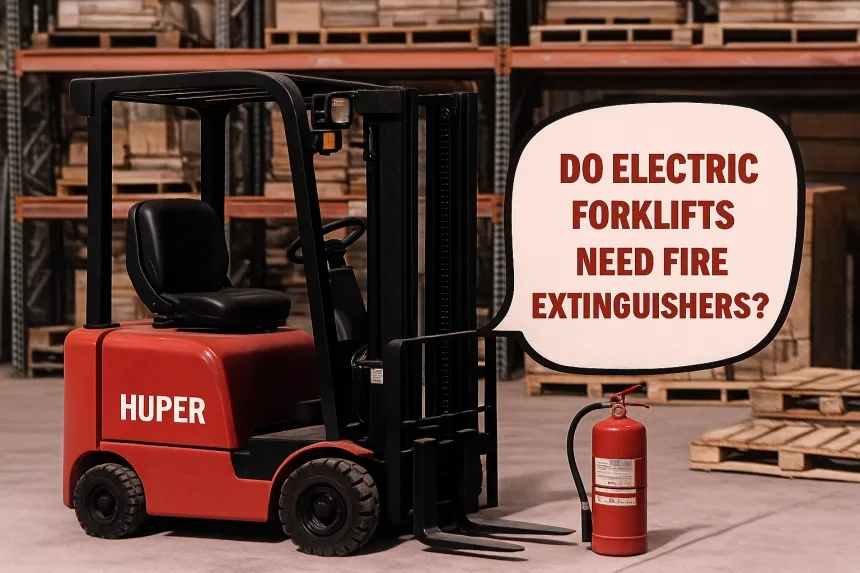
Electric forklifts are widely used in warehouses, logistics centers, manufacturing facilities, and distribution operations. They are often preferred because they produce less noise, have no conventional engine exhaust, and can offer relatively simple maintenance compared with internal combustion forklifts.
However, as electric forklifts become increasingly common, an important safety question is being asked more frequently:Do electric forklifts need fire extinguishers?
The short answer is: not every electric forklift is legally required to have a fire extinguisher mounted directly on the truck. However, this does not mean that electric forklifts are completely free from fire risks or that businesses can ignore fire protection.
1. Why Do Electric Forklifts Still Present a Fire Risk?
The fact that a forklift is electric does not mean that it has zero fire risk.
Compared with diesel or LPG forklifts, electric forklifts do not have conventional fuel tanks or internal combustion engines, which eliminates certain fuel-related fire hazards. However, electric forklifts still contain batteries, electrical wiring, motors, controllers, chargers, and other electrical components that can generate heat or become involved in an electrical fault.
In warehouse environments, forklifts also operate around cardboard boxes, plastic packaging, wooden pallets, paper, textiles, and other combustible materials. If an electrical fault or overheating component creates an ignition source, a fire can potentially spread to surrounding materials.
The UK Health and Safety Executive (HSE) recognizes that electrical equipment can be a source of ignition in workplaces, while materials such as paper, plastics, wood, rubber, and packaging waste can contribute to fire loading.
When assessing the fire safety of an electric forklift, businesses should consider at least the following factors:
The type and condition of the battery.
The method used to charge the battery.
The condition of chargers and electrical cables.
Whether the forklift operates near large quantities of combustible materials.
Whether flammable liquids or other hazardous substances are present.
How many hours the forklift operates each day.
Whether the forklift is properly maintained and routinely inspected.
Whether suitable and accessible fire extinguishers are already available in the workplace.
Whether forklift operators have received appropriate fire safety training.
2. Is a Fire Extinguisher Legally Required on an Electric Forklift?
In the UK workplace environment, it is not accurate to say that every electric forklift must have a fire extinguisher mounted on it.
There is no general requirement that every forklift must carry a fire extinguisher directly on the vehicle. Instead, the need for additional firefighting equipment should be determined through an appropriate workplace fire risk assessment.This distinction is important.There is a difference between saying:
“Every forklift must have a fire extinguisher.”and saying:“The workplace must have suitable fire protection measures based on its assessed risks.”
The Regulatory Reform (Fire Safety) Order 2005 places duties on the responsible person to take appropriate fire precautions and provide suitable firefighting equipment where necessary. Fire risk assessments must also be kept up to date and reviewed when significant changes occur.
In other words:The focus of UK fire safety legislation is controlling fire risk rather than prescribing one identical fire extinguisher arrangement for every forklift.If a risk assessment determines that a particular forklift or operating environment requires a fire extinguisher, the business should implement the recommended control measures.
3. Why Do Some Businesses Still Install Fire Extinguishers on Electric Forklifts?
Although mounting a fire extinguisher directly on every electric forklift is not universally required, there are situations where doing so may provide practical benefits.
3.1 Faster Response to a Small Fire
A forklift may be operating a significant distance away from fixed firefighting equipment.
If a fire occurs, the operator may otherwise need to leave the area, locate a suitable extinguisher, and return to the incident. This can waste valuable time during the early stages of a fire.
Where a risk assessment supports the use of an onboard extinguisher, having suitable equipment readily available may allow a faster response to a small, developing fire.However, it is important to emphasize that:A fire extinguisher is not intended to encourage employees to take unnecessary risks or attempt to fight a large fire.
HSE guidance emphasizes that extinguishers can help people deal with small fires and escape safely. Only appropriately trained personnel should consider attempting to tackle an incipient fire, and only where it is safe to do so.
3.2 Forklifts May Operate Away from Fixed Fire Equipment
Large warehouses, distribution centers, and outdoor operating areas can cover substantial distances.
A forklift may move continuously between different sections of a facility. Although wall-mounted extinguishers are essential components of workplace fire protection, they may not always be immediately accessible from every operating location.
Depending on the risk assessment, businesses may therefore consider mobile firefighting equipment or extinguishers mounted on selected forklifts.
3.3 Reducing the Chance of a Small Incident Becoming a Larger Fire
An electrical fault that is not identified or controlled quickly can potentially result in equipment damage or ignite nearby combustible materials.
For this reason, businesses should consider fire prevention, early detection, emergency notification, evacuation, and appropriate initial firefighting as parts of one overall fire safety strategy.A fire extinguisher should never be viewed as the entire fire protection system.
4. The Battery and Charging Area Deserve Particular Attention
When assessing electric forklift fire safety, businesses should look beyond the forklift itself and pay particular attention to the battery charging area.
For conventional lead-acid forklift batteries, charging introduces additional considerations, including electrical safety, ventilation, and the gases that may be generated during charging.
OSHA guidance on powered industrial trucks recommends appropriate fire protection in battery charging areas and highlights the importance of suitable ventilation. Its guidance also identifies dry chemical, carbon dioxide, and foam extinguishers among the types that may be used in charging areas, depending on the applicable fire hazards.
This highlights an important point:Where the extinguisher is located can be just as important as whether the forklift itself carries one.
If the main fire risk is concentrated in a battery charging area, the business may need to focus more heavily on fire protection around the charging station, ventilation, electrical safety, smoking controls, equipment maintenance, emergency procedures, and employee training rather than simply mounting an extinguisher on every forklift.
5. What About Lithium-Ion Electric Forklifts?
Lithium-ion batteries are increasingly used in modern electric forklifts. They offer advantages such as efficient charging, reduced maintenance requirements, and operational convenience.However, businesses should not assume that lithium-ion batteries are completely free from fire risk.
When using lithium-ion forklift batteries, businesses should pay particular attention to:
Unusual battery temperature increases.
Physical damage to the battery.
Swelling or deformation.
Unusual smells or other abnormal signs.
Whether the charger is compatible with the battery system.
Whether approved charging equipment is being used.
Whether the charging area meets the manufacturer’s requirements.
Whether there is a clear procedure for isolating and reporting damaged or abnormal batteries.
Whether maintenance personnel understand the manufacturer’s safety instructions.
A battery that has been damaged or is showing obvious signs of abnormal operation should not simply be returned to service.For any battery system, there is no universal “one-size-fits-all” extinguisher that can safely address every possible fire scenario. Businesses should consider the battery manufacturer’s safety documentation, the site’s fire risk assessment, and applicable local fire safety requirements when determining the appropriate fire protection strategy.
6. Which Type of Fire Extinguisher Should Be Used for an Electric Forklift?
This is another area that is frequently misunderstood.The fact that a forklift is electric does not automatically mean that a carbon dioxide extinguisher is the only appropriate option.The correct extinguisher depends on the type of fire that could occur.
For example, HSE workplace fire safety guidance explains that different types of fire require appropriate firefighting media. Carbon dioxide extinguishers are commonly associated with certain electrical fire risks, while different extinguishing agents may be more appropriate for combustible solids or flammable liquids.
When selecting firefighting equipment, businesses should consider four key questions.
First: What could actually catch fire?
Could the source be electrical wiring, a battery system, a charger, cardboard packaging, wooden pallets, plastic materials, or flammable liquids?
Second: Is the extinguisher suitable for that fire type?
Businesses should not purchase one extinguisher simply because it is convenient and assume that it will be suitable for every foreseeable fire.
Third: Is the extinguisher accessible?
Firefighting equipment should be positioned where it can be reached quickly and safely. UK government fire risk assessment guidance emphasizes that the type, quantity, and location of extinguishers should reflect the fire risks present in the workplace.
Fourth: Is the mounting arrangement safe?
If an extinguisher is mounted on a forklift, it should be securely attached using an appropriate mounting system designed for a mobile, vibrating environment.
The extinguisher must not obstruct the driver’s visibility, interfere with controls, restrict access, or create another safety hazard.
7. A Fire Extinguisher Should Not be the Entire Electric Forklift Fire Safety Strategy
A comprehensive electric forklift fire safety program should normally include several layers of protection.
7.1 Risk Assessment
Identify potential ignition sources, combustible materials, battery hazards, electrical hazards, and risks to employees.
7.2 Equipment Inspection
Regularly inspect batteries, electrical cables, chargers, connectors, and other forklift electrical components.
7.3 Charging Area Management
Keep charging areas clean and appropriately ventilated, and provide suitable fire protection based on the identified risks.
7.4 Workplace Fire Protection
Ensure that the workplace has enough suitable firefighting equipment and that extinguishers are correctly positioned and readily accessible.
7.5 Employee Training
Employees should understand how to identify abnormal conditions, raise the alarm, evacuate, and follow emergency procedures.Where appropriate, trained employees should also understand the safe and limited use of extinguishers during the early stages of a fire.
7.6 Regular Review
If the business increases the number of forklifts, changes battery technology, modifies the warehouse layout, or introduces additional combustible materials, the fire risk assessment should be reviewed.HSE emphasizes that workplace risk assessments are not one-time documents and should be reviewed when working conditions and risks change.
8. When Should Businesses Consider Putting a Fire Extinguisher on an Electric Forklift?
Although there is no universal rule, the following situations may justify closer consideration:
Forklifts operate continuously in large warehouses.
Forklifts work near large quantities of cardboard, wooden pallets, or plastic packaging.
Forklifts enter areas where flammable materials are stored.
Forklifts frequently operate outdoors or far away from fixed firefighting equipment.
Battery charging areas are located a significant distance from other fire protection equipment.
Forklifts operate for long periods or at high utilization levels.
A large fleet of electric forklifts is used.
The workplace has a relatively high electrical fire risk.
The company’s fire risk assessment recommends additional mobile firefighting equipment.
In these circumstances, rather than asking only whether an extinguisher is legally mandatory, businesses should consider whether carrying one would be a sensible risk-control measure.
9. How Can a Business Create an Electric Forklift Fire Safety Checklist?
Step 1: Identify the Fire Hazards
Inspect batteries, chargers, electrical systems, combustible packaging, flammable liquids, and other potential ignition sources.
Step 2: Assess the People at Risk
Identify how forklift operators, warehouse employees, maintenance personnel, contractors, and visitors could be affected by a fire.
Step 3: Determine the Required Fire Protection
Select appropriate extinguishers and other firefighting equipment according to the types of fires that could realistically occur.
Step 4: Provide Training and Emergency Procedures
Employees should understand how to raise the alarm, evacuate, reach the assembly point, and contact emergency services. Only trained personnel should consider attempting to tackle a small fire, and only where it is safe to do so.
Step 5: Review the Assessment Regularly
When forklifts, batteries, warehouse layouts, charging systems, or operating procedures change, the associated fire risks should be reassessed.This approach is consistent with the broader UK fire safety principle of identifying hazards, assessing risks, implementing controls, providing training, and reviewing the assessment when circumstances change.
10. Final Answer: Do Electric Forklifts Need Fire Extinguishers?
Not necessarily. However, businesses must provide appropriate fire protection based on the actual risks associated with their electric forklifts and working environment.
Electric forklifts do not have conventional fuel engines, but they can still present fire risks involving batteries, electrical systems, chargers, and surrounding combustible materials such as cardboard, plastics, and wooden pallets.
In the UK, fire safety requirements focus on workplace fire risk assessment rather than requiring every electric forklift to carry a fire extinguisher. The risk assessment should determine the appropriate type, number, and location of firefighting equipment. Where necessary, a business may decide to install a suitable extinguisher directly on a forklift.
For business owners and warehouse managers, the most useful approach is therefore not simply to ask whether an extinguisher is “required.”Instead, ask three questions:
الأسئلة الشائعة
1. Are electric forklifts legally required to have fire extinguishers?
Not necessarily. In the UK, there is no general requirement that every electric forklift must have a fire extinguisher mounted on the truck. Businesses should determine the need for onboard extinguishers and other firefighting equipment through an appropriate workplace fire risk assessment.
2. Can an electric forklift catch fire?
Yes. Although electric forklifts do not use diesel or LPG engines, they contain batteries, motors, electrical wiring, controllers, and charging systems. Damage, overheating, poor maintenance, or electrical faults can increase the risk of fire.
3. Should an electric forklift have a carbon dioxide fire extinguisher?
A carbon dioxide extinguisher is commonly used for certain electrical fire risks, but it is not automatically the correct solution for every possible fire involving an electric forklift. The appropriate extinguisher should be selected according to the specific fire risks identified in the workplace.
4. Should fire extinguishers be mounted on the forklift or placed in the charging area?
There is no single answer that applies to every workplace. If the primary risk is concentrated in the charging area, that area should receive particular attention. If forklifts regularly operate far away from fixed fire equipment, the business may also consider carrying suitable extinguishers on selected forklifts.
5. Are lithium-ion forklift batteries free from fire risk?
No. Lithium-ion batteries still require appropriate risk management. Physical damage, abnormal heating, unsuitable charging equipment, or improper maintenance can increase the risk of a battery-related incident. Manufacturer safety requirements should always be followed.
6. Do forklift operators need to be trained to use fire extinguishers?
Businesses should determine training requirements based on their fire risk assessment and emergency procedures. Employees should understand how to raise the alarm and evacuate safely. Only appropriately trained personnel should consider using an extinguisher, and only when it is safe to do so.
7. If an electric forklift catches fire, should the operator try to extinguish it or evacuate?
Personal safety should always come first. If the fire is spreading, producing significant smoke, or presents a battery-related or other serious hazard, employees should not put themselves at risk to save equipment. They should raise the alarm, evacuate, and follow the company’s emergency procedures.
8. How often should an electric forklift fire risk assessment be reviewed?
The assessment should be kept up to date and reviewed when circumstances change. This is particularly important when a company changes battery technology, adds more forklifts, modifies the warehouse layout, increases combustible storage, or changes its charging arrangements.
9. Do electric forklifts and diesel forklifts have the same fire risks?
No. Diesel forklifts involve risks associated with fuel, hot engine components, and exhaust systems, while electric forklifts have risks associated more closely with batteries, electrical systems, and charging. Both types can present fire hazards, but the sources of those hazards are different.
10. What is the simplest way to determine whether an electric forklift needs a fire extinguisher?
Remember this principle:Do not start by asking whether the forklift has a fire extinguisher. Start by asking what fire protection measures the workplace’s risk assessment requires.This is the key to developing a practical, compliant, and sustainable electric forklift fire safety strategy.
 AR
AR  EN
EN  EN_AU
EN_AU  EN_NZ
EN_NZ  FR
FR  KO
KO  ES
ES  PT
PT  IT
IT  DE
DE  RU
RU  JA
JA  HU
HU