

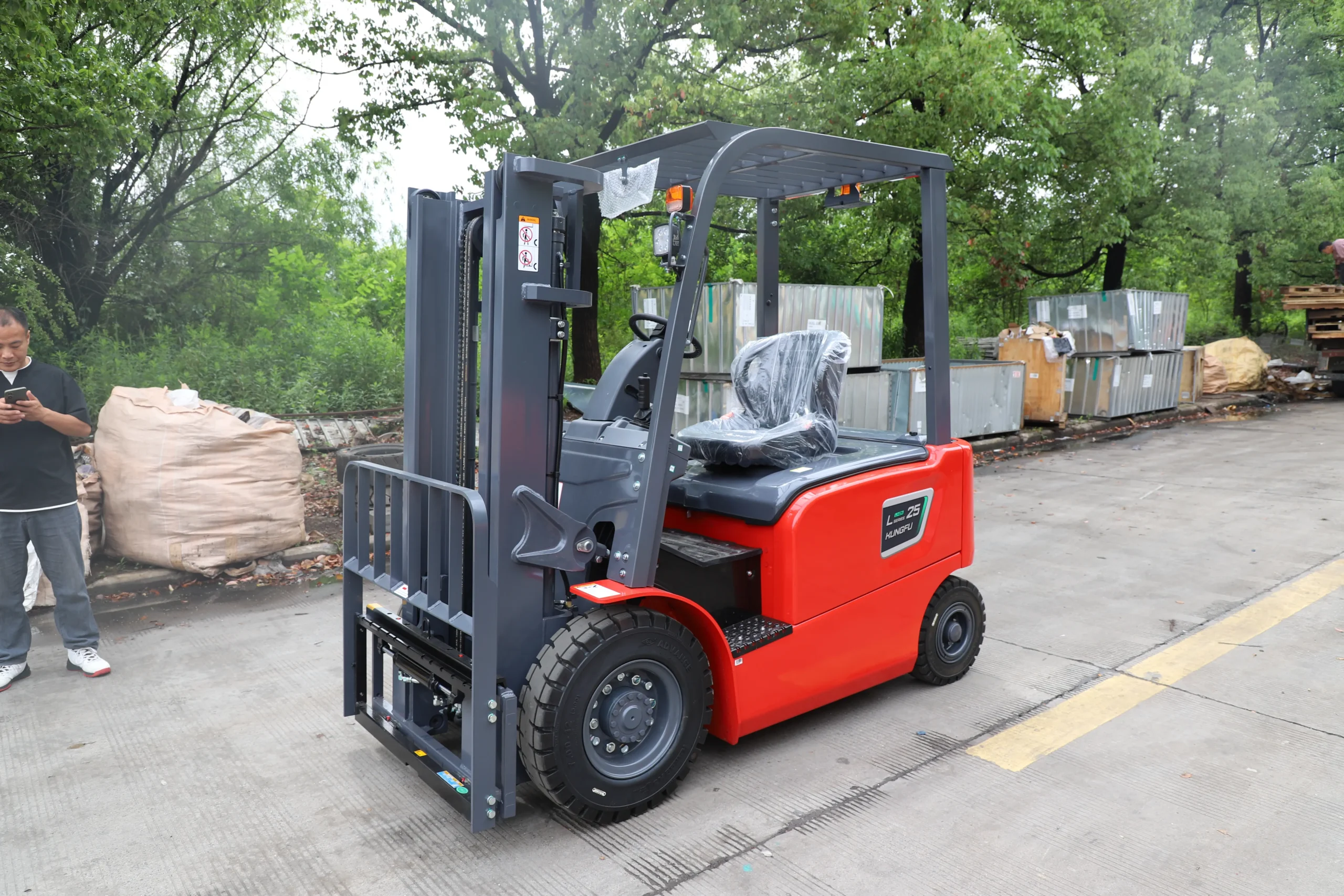


Description
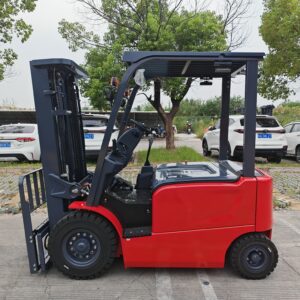
A lithium battery 4-wheel electric forklift is an electric forklift powered by a lithium battery and equipped with a four-wheel design. It is mainly used for pallet handling, stacking, loading and unloading, and internal warehouse transportation. Compared with traditional fuel-powered forklifts and lead-acid battery electric forklifts, a lithium battery 4-wheel electric forklift combines lithium battery technology, an efficient electric drive system, and a stable four-wheel structure, providing significant advantages in operating efficiency, charging convenience, low noise, and environmental performance.
As modern warehousing, manufacturing, and logistics industries place increasing emphasis on high efficiency, lower operating costs, and environmentally friendly working conditions, the lithium battery 4-wheel electric forklift has become an important material handling solution for factories, logistics centers, distribution warehouses, and commercial storage facilities.
What Is Lithium Battery 4-Wheel Electric Forklift?
A lithium battery 4-wheel electric forklift can simply be understood as a four-wheel electric forklift powered by a lithium battery. It uses a lithium battery pack to provide electrical energy, an electric motor to drive the forklift, and a hydraulic system to lift, lower, and handle goods.
Compared with a three-wheel electric forklift, a lithium battery 4-wheel electric forklift features a four-wheel support structure that provides good stability when handling medium- and heavy-duty loads. The four-wheel design also allows the forklift to adapt to a wider range of industrial and warehousing applications.
The lithium battery is one of the key features of this type of forklift. Compared with traditional lead-acid batteries, lithium batteries generally offer high energy efficiency and more flexible charging options. For businesses that operate forklifts for long hours, use them frequently, or require multiple shifts, a lithium battery 4-wheel electric forklift can reduce charging-related downtime through proper battery capacity selection and charging solutions.
Therefore, a lithium battery 4-wheel electric forklift is more than a conventional electric forklift equipped with a different battery. It is an efficient electrified material handling solution designed to meet the requirements of modern warehousing and industrial operations.
Benefits of Lithium Battery 4-Wheel Electric Forklift
The key advantage of a lithium battery 4-wheel electric forklift is the combination of the flexible charging characteristics of lithium batteries with the stability of a four-wheel forklift. This combination makes it suitable for a wide range of high-frequency material handling applications.
1. Efficient Charging
Lithium batteries generally offer good charging efficiency. With a suitable battery and charger configuration, charging downtime can be reduced. This is particularly important for warehouses and logistics centers that require continuous forklift operations.
2. Opportunity Charging Capability
Some lithium battery 4-wheel electric forklift configurations support opportunity charging. The forklift can be recharged during breaks, shift changes, or temporary periods of downtime, helping improve equipment utilization.
3. Lower Maintenance Requirements
Lithium batteries do not require the regular water replenishment associated with traditional lead-acid batteries. Combined with an electric drive system, this can reduce certain routine maintenance tasks.
4. Low Operating Noise
A lithium battery 4-wheel electric forklift uses an electric motor rather than a combustion engine. It produces no engine exhaust during operation and generally operates with lower noise, making it suitable for indoor warehouses and production facilities.
5. Stable Four-Wheel Structure
The four-wheel design provides good vehicle support and stability, making the forklift suitable for handling pallets, machinery components, steel materials, packaged goods, and other types of industrial cargo.
6. Suitable for High-Frequency Operations
With the appropriate battery capacity, charging equipment, and operating configuration, a lithium battery 4-wheel electric forklift can support long-hour and high-frequency material handling operations.
7. Suitable for Green Warehousing
Because there are no fuel-engine exhaust emissions during normal operation, a lithium battery 4-wheel electric forklift is particularly suitable for workplaces where environmental conditions, air quality, and noise control are important.
Applications of Lithium Battery 4-Wheel Electric Forklift
A lithium battery 4-wheel electric forklift offers excellent versatility and can be used in a wide range of industries and material handling applications.
In warehouses and logistics centers, it can be used for pallet handling, cargo stacking, rack loading and unloading, and internal warehouse transportation.
In manufacturing plants, a lithium battery 4-wheel electric forklift can transport raw materials, components, packaging materials, and finished products, reducing the need for manual material handling.
In logistics distribution centers, forklifts are frequently required for loading, unloading, and short-distance transportation. A lithium battery solution can improve equipment utilization through flexible charging.
In the food and beverage industry, electric forklifts produce no fuel-engine exhaust during operation, making them suitable for working areas where cleanliness and air quality are important.
In electronics and precision manufacturing, the low-noise and zero-exhaust characteristics of a lithium battery 4-wheel electric forklift make it suitable for material handling in certain indoor production environments.
In addition, lithium battery 4-wheel electric forklift models can be used in automotive component manufacturing, machinery manufacturing, wholesale warehousing, retail distribution, industrial processing, and third-party logistics.
For companies that handle palletized goods for long hours every day, selecting the right lithium battery 4-wheel electric forklift can help improve internal warehouse material handling efficiency.
Lithium Battery 4-Wheel Electric Forklift VS Lead-Acid Battery Electric Forklift
A lithium battery 4-wheel electric forklift and a four-wheel electric forklift equipped with a lead-acid battery can both perform basic material handling tasks, but the two battery solutions differ in terms of user experience and operating methods.
Charging:
Lead-acid batteries generally require a complete charging cycle and may require additional charging and cooling time during continuous operations. Lithium batteries are more suitable for flexible charging, and some solutions support opportunity charging.
Maintenance:
Lead-acid batteries typically require electrolyte-related maintenance, while lithium batteries generally do not require traditional water replenishment under normal operating conditions. As a result, a lithium battery 4-wheel electric forklift can reduce certain battery maintenance tasks.
Operating Efficiency:
For high-frequency applications, lithium batteries can reduce equipment downtime through fast charging or opportunity charging. Therefore, a lithium battery 4-wheel electric forklift can be particularly suitable for certain multi-shift and high-utilization operations.
Initial Investment:
Lead-acid batteries generally have a lower initial purchase cost, while lithium battery solutions may require a higher initial investment. Therefore, when selecting a lithium battery 4-wheel electric forklift, businesses should also consider service life, workload, electricity costs, maintenance requirements, and overall operating costs.
If a company uses forklifts for long hours every day and places greater emphasis on long-term operating efficiency, a lithium battery 4-wheel electric forklift is worth serious consideration.
What Factors Should You Consider When Choosing Lithium Battery 4-Wheel Electric Forklift
When purchasing a lithium battery 4-wheel electric forklift, the right choice should be based on actual operating conditions rather than simply comparing forklift prices.
First, determine the rated load capacity.
Select the appropriate forklift capacity based on the maximum weight of the goods to be handled, while also considering the load center and actual lifting height.
Second, determine the lifting height.
If the forklift will be used for high-level rack stacking, select the appropriate mast and lifting configuration according to the rack height.
Third, evaluate daily operating hours.
A forklift operating for 2–4 hours per day has different battery and charging requirements from one operating continuously for 8–16 hours.
Fourth, determine the working environment.
Consider whether the forklift will be used indoors or outdoors, whether the floor is level, the aisle width, slopes, operating temperature, and whether dust or moisture is present.
Fifth, select the appropriate lithium battery capacity.
A larger battery is not necessarily better. Battery capacity should be matched to the forklift load, operating hours, and charging conditions.
Sixth, consider attachment requirements.
If special goods need to be handled, attachments such as side shifters, different fork lengths, or other specialized equipment may be required.
Seventh, consider after-sales service.
Technical support and spare parts availability for batteries, controllers, chargers, motors, and other key components are important for the long-term operation of a lithium battery 4-wheel electric forklift.
Eighth, consider the total cost of ownership.
In addition to the initial purchase price, businesses should evaluate energy consumption, battery service life, maintenance requirements, productivity, and expected operating life to make a more informed purchasing decision.
What Regular Maintenance does Lithium Battery 4-Wheel Electric Forklift Require?
Although a lithium battery 4-wheel electric forklift generally requires less routine maintenance than a traditional internal combustion forklift, regular inspection and maintenance are still important.
First, regularly inspect the lithium battery and battery connection system. Check the battery condition, connectors, and related wiring to ensure there are no signs of abnormal heating, looseness, or damage.
Second, inspect the charger and charging connector to ensure that the charging equipment operates correctly and that the battery is charged according to the manufacturer’s recommended procedures.The tires, braking system, steering system, and hydraulic system should also be inspected regularly. These components are directly related to safe forklift operation.The mast and forks should be checked for excessive wear, deformation, cracks, or other visible damage. Since the forks directly support the load, they are critical components that require regular inspection.
In addition, the lights, horn, safety warning devices, and instrument display should be checked to ensure that they function properly.For a long-term lithium battery 4-wheel electric forklift, it is recommended to maintain service records and establish daily, weekly, and periodic maintenance schedules based on the actual frequency of use.
What Tests Does Lithium Battery 4-Wheel Electric Forklift Undergo?
To ensure that a lithium battery 4-wheel electric forklift meets normal operating requirements, the forklift typically undergoes multiple inspections and performance tests before delivery.
The first is a complete vehicle operation test.
which may include forward and reverse driving, steering, braking, and basic performance checks at different operating speeds.
The second is a lifting and hydraulic system test.
which checks whether the mast lifting, lowering, and hydraulic functions operate smoothly and reliably.
The third is a rated load-related test.
which evaluates the forklift’s load-handling and lifting capabilities according to its design and applicable standards.
The fourth is an electrical system test.
which may include inspection of the motor, controller, wiring, instruments, safety protection functions, and charging system.
The fifth is a battery system inspection to verify that the lithium battery, battery management system, and related connection components meet the product design requirements.Additional safety, mechanical, electrical, and compliance inspections may also be conducted depending on the forklift model, target market, and customer requirements.The exact test items and applicable standards for a lithium battery 4-wheel electric forklift depend on the specific model, rated capacity, configuration, destination country, and applicable local requirements.
What Customization Options Are Available for Our Lithium Battery 4-Wheel Electric Forklift?
Different customers have different working environments and material handling requirements. Therefore, our lithium battery 4-wheel electric forklift supports a variety of configurations and customization options.
Customers can select different rated load capacities and forklift models according to their specific requirements for light-, medium-, or heavy-duty material handling.
For the mast, different lifting heights and mast configurations can be selected according to rack height. Different fork lengths and specifications can also be provided according to cargo dimensions.
For the power system, customers can choose different lithium battery capacities according to daily operating hours and charging conditions, together with compatible chargers.
Our lithium battery 4-wheel electric forklift can also be configured with different tires, operator seats, lighting systems, safety warning devices, controllers, and other electrical components.
For special cargo handling applications, side shifters and other specialized attachments can be configured according to actual working conditions to improve forklift versatility and operating efficiency.
For distributors, logistics companies, manufacturing plants, and large project customers, we can also provide OEM/ODM customization services, including product colors, nameplates, company logos, and selected product configurations.
For export projects, we can provide relevant technical documentation, product documents, and compliance support according to the requirements of the target market.
If you are looking for a lithium battery 4-wheel electric forklift for long-term, high-frequency warehouse and industrial material handling, we can recommend a suitable model, battery capacity, and configuration based on your load weight, lifting height, operating hours, aisle width, and working environment.
The right lithium battery 4-wheel electric forklift can do more than handle materials. It can help businesses improve warehouse efficiency, reduce certain maintenance requirements, and optimize long-term operating costs. Contact us to receive detailed lithium battery 4-wheel electric forklift specifications, configuration recommendations, and a quotation.
Performance Parameters
| Type | Item | unit | Model | |||
| Model | CPD15 | CPD18 | CPD15 | CPD18 | ||
| Mode | POWERFUL | FUNCTIONAL | ||||
| Features | Rated load | kg | 1500 | 1500 | 1500 | 1800 |
| Load center distance | mm | 500 | 500 | 500 | 500 | |
| Power mode | Lithium | Lithium | Lithium | Lithium | ||
| Driving mode | Seat | Seat | Seat | Seat | ||
| Front overhang | mm | 407 | 407 | |||
| Wheelbase | mm | 1475 | 1475 | 1475 | 1475 | |
| Weight | Service weight (including battery/excluding battery) | kg | 2840/2610 | 2955/2780 | 2850/2675 | 2965/2790 |
| Axle load (full load, front/rear) | kg | 3865/475 | 4185/570 | 3870/480 | 4190/575 | |
| Axle load (no load, front/rear) | kg | 1280/1560 | 1280/1675 | 1285/1565 | 1285/1680 | |
| Type | Tire type | Pneumatic tire | Pneumatic tire | Pneumatic tire | Pneumatic tire | |
| Front tire size | 6.50-10PR | 6.50-10PR | 6.50-10PR | 6.50-10PR | ||
| Rear tire size | 16*6-8PR | 16*6-8PR | 16*6-8PR | 16*6-8PR | ||
| Number of wheels, front/rear (x=drive wheels) | n | 2/2 | 2/2 | 2/2 | 2/2 | |
| Front wheel tread | mm | 934 | 934 | 934 | 934 | |
| Rear wheel tread | mm | 920 | 920 | 920 | 920 | |
| Dimensions | Mast tilt angle(FR/RR) | ° | 6/8 | 6/8 | 6/8 | 6/8 |
| Mast lowered height | mm | 2010 | 2010 | 2010 | 2010 | |
| Free lift height | mm | 115 | 115 | 115 | 115 | |
| Lift height | mm | 3000 | 3000 | 3000 | 3000 | |
| Mast height at maximum lift (with backrest) | mm | 3935 | 3935 | 3935 | 3935 | |
| Height of overhead guard | mm | 2130 | 2130 | 2130 | 2130 | |
| Seat SIP point height (to the ground) | mm | 1125 | 1125 | 1125 | 1125 | |
| The height of the traction pin position | mm | 250 | 250 | 250 | 250 | |
| Overall length(with forks) | mm | 3117 | 3117 | 3117 | 3117 | |
| Overall length(without forks) | mm | 2197 | 2197 | 2197 | 2197 | |
| Overall width | mm | 1120 | 1120 | 1120 | 1120 | |
| Backrest, ISO2328 standard | 2 | 2 | 2 | 2 | ||
| Fork size LxWxT | mm | 920x100x35 | 920x100x35 | 920x100x35 | 920x100x35 | |
| Outer spacing of forks, maximum/minimum | mm | 970/200 | 970/200 | 970/200 | 970/200 | |
| Ground clearance(Full load, at mast) | mm | 110 | 110 | 110 | 110 | |
| Ground clearance(Full load, at wheelbase Center) | mm | 95 | 95 | 95 | 95 | |
| Minimum right angle stacking aisle width, Pallet1000*1200 (1200 forks placed) | mm | 3665 | 3665 | 3665 | 3665 | |
| Minimum right angle stacking aisle width, Pallet800*1200 (1200 forks placed) | mm | 3865 | 3865 | 3865 | 3865 | |
| Minimum turning radius | mm | 2010 | 2010 | 2010 | 2010 | |
| Performance | Maximum travel speed(full load/no load) | km/h | 15/15 | 15/15 | 18/18 | 18/18 |
| Maximum lift speed(full load/no load) | mm/s | 320/440 | 300/440 | 400/520 | 380/520 | |
| Lowering speed (full load/no load) | mm/s | 400/400 | 400/400 | 400/400 | 400/400 | |
| Maximum drawbar pull(full load/no load) | kN | 10.2/9.7 | 10.2/9.8 | 12/10.7 | 12/11 | |
| Maximum gradeability(full load/no load) | % | 17/27 | 15/26 | 20/27 | 18/26 | |
| Acceleration time (10 meters) (full load/empty load) | s | 5.5/5.3 | 5.6/5.3 | 5.5/5.1 | 5.7/5.4 | |
| Battery | Lithium battery voltage/capacity | V/Ah | 80/125 | 80/125 | 80/150 | 80/150 |
| Lithium battery weight | kg | 165 | 165 | 175 | 175 | |
| Motor and controller | Drive motor power | kW | 11 | 11 | 11 | 11 |
| Lifting motor power | kW | 14 | 14 | 14 | 14 | |
| Way of control | AC | AC | AC | AC | ||
| Others | Driving brake/parking brake | Hydraulic/mechanical | Hydraulic/mechanical | Hydraulic/mechanical | Hydraulic/mechanical | |
| Operating pressure | Mpa | 16 | 16 | 16 | 16 | |
FAQ
1. How can I determine whether a lithium battery 4-wheel electric forklift is suitable for my factory or warehouse?
To determine whether a lithium battery 4-wheel electric forklift is suitable for your operation, consider the load weight, cargo dimensions, lifting height, daily operating hours, number of shifts, aisle width, floor conditions, and indoor or outdoor environment.
If your business handles palletized goods for long hours and high frequency and you want to reduce charging downtime and battery maintenance, a lithium battery 4-wheel electric forklift can be a suitable solution.If you provide the maximum load weight, lifting height, daily operating hours, and warehouse aisle width, we can help recommend the appropriate forklift capacity, battery capacity, and configuration.
2. What factors affect the price of a lithium battery 4-wheel electric forklift?
The final price of a lithium battery 4-wheel electric forklift depends on more than the forklift itself. Key factors include rated load capacity, lithium battery capacity, lifting height, mast type, tires, controller, charger, and attachment configuration.
For example, a forklift with a higher load capacity, greater lifting height, or larger battery capacity will generally require a different configuration and cost structure.When comparing quotations from different suppliers, it is recommended to compare forklifts with the same rated capacity, lifting height, battery capacity, and similar specifications, rather than comparing the total price alone.
3. Is the initial purchase cost of a lithium battery 4-wheel electric forklift high?
Compared with some lead-acid battery electric forklifts, the initial purchase cost of a lithium battery 4-wheel electric forklift may be higher.
However, purchasing decisions should not be based solely on the initial equipment price. Businesses should also evaluate operating frequency, charging efficiency, maintenance requirements, battery service life, energy costs, and long-term operating expenses.For companies with long operating hours or multiple shifts, the flexible charging characteristics and lower battery maintenance requirements of lithium batteries may provide better long-term value.
Therefore, it is recommended to evaluate the total cost of ownership (TCO) rather than focusing only on the initial purchase price.
4. Is a lithium battery 4-wheel electric forklift suitable for multi-shift operations?
Yes, but the battery capacity and charging solution should be selected according to the actual workload.For warehouses, logistics centers, and manufacturing facilities that operate continuously, a larger lithium battery can be selected and combined with fast charging or opportunity charging solutions.
Battery configuration is particularly important for multi-shift applications. Before purchasing a lithium battery 4-wheel electric forklift, customers should provide information about daily operating hours, working hours per shift, and average load conditions so that the appropriate battery solution can be selected.
5. What lithium battery capacity should I choose for a lithium battery 4-wheel electric forklift?
Battery capacity should be selected according to actual operating conditions rather than simply choosing the largest available battery.Important factors include forklift rated capacity, daily operating hours, travel distance, lifting frequency, working environment, and charging conditions.
If the forklift operates only a few hours per day, an oversized battery may result in unnecessary initial investment. If the forklift operates multiple shifts every day, a larger battery capacity and a suitable charging solution may be required.We can recommend an appropriate battery capacity based on your actual operating conditions.
6. Can a lithium battery 4-wheel electric forklift be customized?
Yes. Different businesses may have different requirements for load capacity, lifting height, fork dimensions, tires, batteries, chargers, safety configurations, and attachments.
Our lithium battery 4-wheel electric forklift can be supplied with different configurations, including various rated load capacities, mast heights, fork specifications, lithium battery capacities, tire types, lighting systems, safety devices, and side shifters.For distributors and bulk purchasing customers, OEM/ODM customization is also available according to project requirements, including product colors, nameplates, and company logos.
7. Should I purchase a standard model directly or ask the supplier to recommend a configuration based on my application?
If you already know your load weight, lifting height, operating hours, and working environment, you can select a standard model that meets your requirements.
However, for first-time buyers of a lithium battery 4-wheel electric forklift, or for businesses with complex operating conditions, it is generally better to provide detailed application information and ask the supplier to recommend a suitable configuration.
A professional forklift supplier should help customers determine key specifications such as load capacity, lifting height, battery capacity, mast, tires, and attachments, rather than simply providing a product price.This can help prevent problems such as insufficient load capacity, inadequate battery runtime, or an unsuitable forklift configuration after purchase.
8. What support is available for bulk purchases of lithium battery 4-wheel electric forklifts?
For bulk purchasing projects, we can provide product solutions based on the customer’s purchase quantity, application, and target market.
Available support may include model selection, configuration matching, technical specifications, product documentation, certification documents, OEM/ODM customization, and after-sales technical support.For forklift distributors and long-term buyers, we can also discuss long-term cooperation and customized product solutions according to market requirements.
9. What should I consider when purchasing a lithium battery 4-wheel electric forklift for export?
For export purchases, product performance and price are important, but buyers should also consider certification, import requirements, electrical specifications, charger standards, packaging and transportation, and after-sales spare parts.
Before purchasing a lithium battery 4-wheel electric forklift, it is recommended to confirm the compliance requirements of the destination market and request the relevant technical documentation and certification documents from the supplier.For projects in different countries, we can provide corresponding product configurations and documentation according to customer requirements.
10. What after-sales service is available after purchasing a lithium battery 4-wheel electric forklift?
A forklift is an industrial vehicle designed for long-term use, so after-sales service is an important part of the purchasing decision.
When purchasing a lithium battery 4-wheel electric forklift, customers should consider whether the supplier can provide operating guidance, technical support, spare parts, and troubleshooting assistance.
We can provide operating documentation, maintenance recommendations, and technical support according to customer requirements. For long-term customers, we can also provide relevant spare parts and after-sales support to help reduce equipment downtime and maintain stable operation.
11. What information should I provide to get an accurate quotation for a lithium battery 4-wheel electric forklift?
To receive an accurate quotation, it is recommended to provide the following information:
Maximum load weight;
Cargo dimensions and pallet specifications;
Required maximum lifting height;
Daily operating hours;
Number of working shifts per day or week;
Indoor or outdoor application;
Floor and aisle conditions;
Whether attachments such as a side shifter are required;
Destination country or target market;
Required lithium battery capacity or charging solution;
Required purchase quantity.
The more complete the information, the easier it is for the supplier to recommend the right lithium battery 4-wheel electric forklift and provide an accurate configuration and quotation.
12. Why should I choose our lithium battery 4-wheel electric forklift?
We do more than supply lithium battery 4-wheel electric forklift products. We also provide model selection and configuration recommendations based on each customer’s actual operating conditions.
Whether you are an end user, logistics company, manufacturer, warehouse operator, or forklift distributor, you can select the appropriate load capacity, battery, mast, and attachment configuration according to your application.
From initial model selection and product configuration to export documentation, OEM/ODM customization, and after-sales technical support, we are committed to providing a complete electric forklift purchasing solution rather than simply supplying a standardized piece of equipment.
If you are looking for a lithium battery 4-wheel electric forklift for long-term warehousing and industrial material handling, provide us with your load weight, lifting height, operating hours, working environment, and purchase quantity. Our team can recommend the appropriate model and configuration and provide a detailed quotation.
FUNCTION/DEVICE Standard and Options
| Category | Items | Standard & Options |
| Basic items | Pneumatic tyre* | ● |
| Solid tyre | ○ | |
| Single tyre (front wheel) | ● | |
| Double front tyres (front wheels) | ○ | |
| 2th valve | ● | |
| 3th & 4th valve | ○ | |
| 3m duplex mast | ● | |
| Other types and different height masts | ○ | |
| Standard forks | ● | |
| Non-standard forks and attachments | ○ | |
| Standard colors | ● | |
| other colors(customized) | ○ | |
| Security items | Turning speed limit | ○ |
| Reversing handrail with horn switch | ○ | |
| Alarm for speeding at 5km/h | ○ | |
| Alarm for speeding at 8km/h | ○ | |
| Alarm for speeding at 10km/h | ○ | |
| Emergency power-off switch | ● | |
| OPS functions | ● | |
| Seat belt start switch (Seat belt fastening required to start.) | ○ | |
| Multi-way valve overload protection | ● | |
| Dry powder fire extinguisher (2kg) | ○ | |
| Back-up buzzer | ● | |
| Reversing Chinese voice speaker | ○ | |
| Non-universal key | ● | |
| Universal key | ○ | |
| Electronic lifting buffer | ○ | |
| Central wide-angle rearview mirror | ● | |
| Side mirrors + central wide-angle rearview mirror | ○ | |
| Comfort items | Half-enclosed seat | ● |
| Suspension seat | ○ | |
| USB port(5V/1A) | ● | |
| Rotable steering wheel in place | ○ | |
| Synchronous steering | ○ | |
| Steering wheel with handle ball | ● | |
| Fan | ○ | |
| Cab and air conditioner | Cab (including fan + wiper) | ○ |
| heater | ○ | |
| Cooling air conditioner | ○ | |
| heater + Cooling air conditioner | ○ | |
| Front windshield (with wiper) | ○ | |
| Rear windshield | ○ | |
| Rainproof roof | ○ | |
| Overhead guard | Overhead guards of different heights | ○ |
| Overhead guards with protective cover | ○ | |
| Lighting items | Rear LED light | ○ |
| Forward LED red/blue light | ○ | |
| Rear LED red/blue light | ○ | |
| Red/blue light on the left, right and back three sides | ○ | |
| LED flashing warning light | ● | |
| LED rotating warning light | ○ | |
| LED rotating buzzer warning light | ○ | |
| others | REMA320 charging port | ● |
| National standard charging gun | ○ | |
| board charger | ○ | |
| ●Standard; ○Optional; Some non-standard options need to be customized. Please consult the local salesperson before purchasing. | ||
| *Standard solid tyres for 3-3.5ton’s rear wheel |



 EN
EN  EN_AU
EN_AU  EN_NZ
EN_NZ  AR
AR  FR
FR  KO
KO  ES
ES  PT
PT  IT
IT  DE
DE  RU
RU  JA
JA  HU
HU
Reviews
There are no reviews yet.