

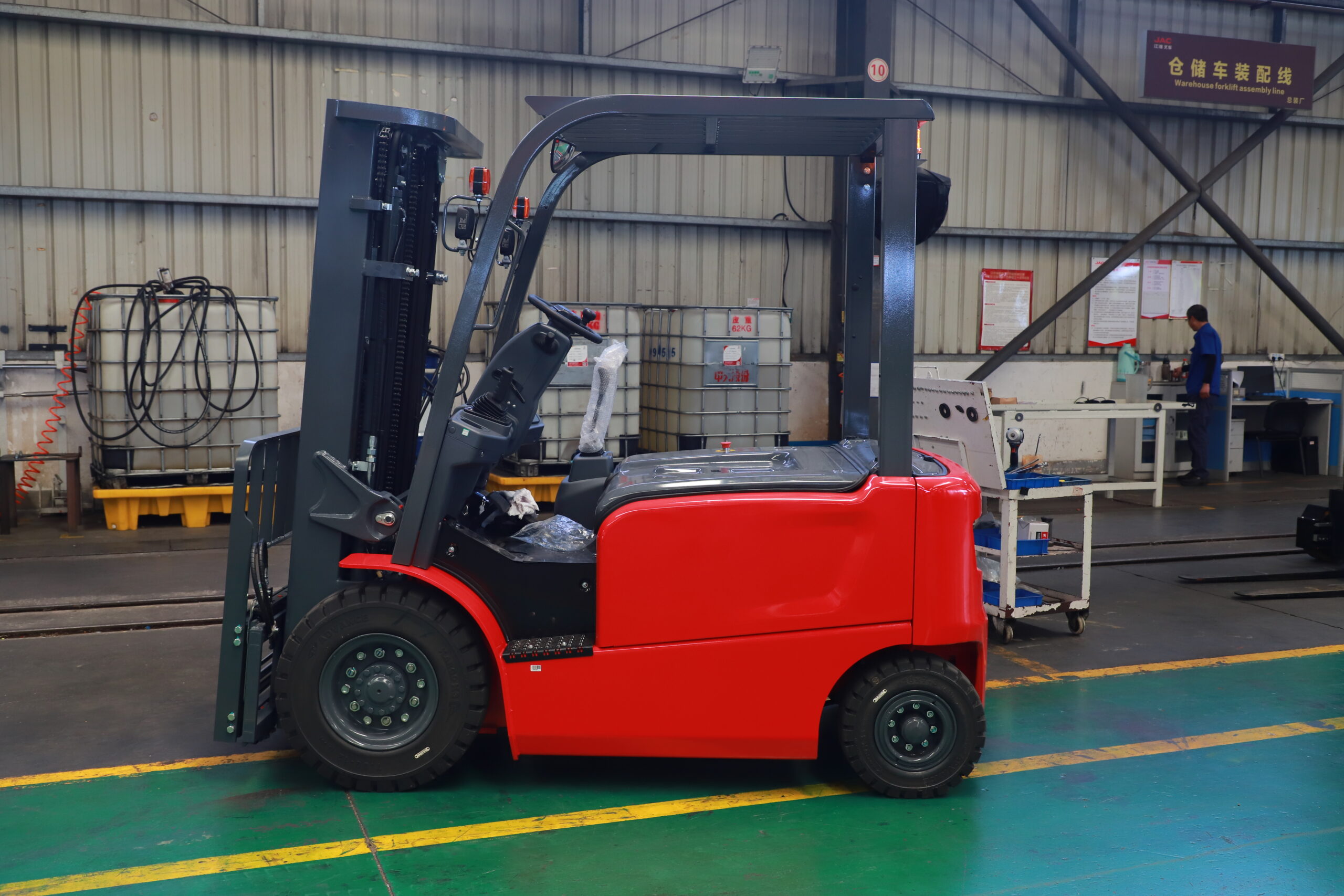


Description
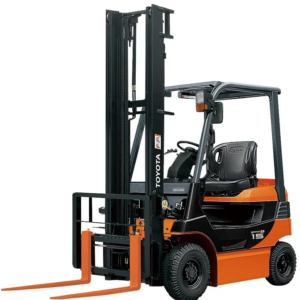
A 4 wheel electric forklift is a material handling vehicle powered by a battery and equipped with a four-wheel design. It is widely used in warehousing, manufacturing, logistics, retail, food and beverage, and industrial production. Compared with traditional internal combustion forklifts, a 4 wheel electric forklift offers low operating noise, zero exhaust emissions, flexible handling, and relatively low maintenance requirements, making it particularly suitable for indoor applications and workplaces with high environmental requirements.
Why Choose a 4 Wheel Electric Forklift?
In warehousing, logistics, and industrial production, forklifts often need to perform material handling, stacking, loading, and unloading operations for long periods. Therefore, equipment stability, operating efficiency, and overall operating costs are important factors to consider. Choosing a 4 wheel electric forklift can meet daily material handling requirements while helping businesses reduce long-term operating costs.
The four-wheel design provides good overall stability, allowing the forklift to maintain a balanced and stable posture when handling different loads. The electric drive system also eliminates the exhaust emissions and reduces the noise associated with fuel-powered forklifts, making it more suitable for warehouses, workshops, and other indoor working environments.
In addition, the powertrain of an electric forklift is relatively simple and does not require frequent engine oil and filter replacement associated with traditional internal combustion forklifts. This can help reduce certain routine maintenance requirements. For businesses that require long-term and high-frequency material handling, a 4 wheel electric forklift provides a practical balance between performance and operating costs.
Benefits of a 4 Wheel Electric Forklift
1. Excellent Stability
The four-wheel design provides good load stability and is suitable for handling and stacking pallets, boxes, raw materials, and various other types of goods.
2. Low Operating Noise
The electric drive system operates with relatively low noise, helping create a quieter and more comfortable working environment in warehouses and production facilities.
3. Zero Exhaust Emissions
A 4 wheel electric forklift does not produce engine exhaust emissions during operation, making it particularly suitable for food, pharmaceutical, electronics, warehousing, and other applications where environmental cleanliness is important.
4. Flexible Operation
The electric drive system provides responsive operation. Combined with a compact vehicle design and precise steering control, the forklift can perform material handling tasks efficiently in warehouses, workshops, and other areas with limited space.
5. Easy Maintenance
The electric powertrain eliminates many engine-related maintenance requirements, helping reduce routine maintenance work and potentially lowering long-term maintenance costs.
6. Suitable for High-Frequency Operations
With the right battery capacity, charging solution, and configuration for the workload, a 4 wheel electric forklift can meet the requirements of various continuous material handling operations.
Main Applications of a 4 Wheel Electric Forklift
A 4 wheel electric forklift offers excellent versatility and can be used across a wide range of industries and working environments, including:
Warehousing and Logistics:
Used for pallet handling, loading and unloading, rack stacking, and internal warehouse transportation.
Manufacturing:
Used to transport raw materials, components, semi-finished products, and finished goods.
Distribution Centers:
Suitable for cargo loading and unloading, short-distance transportation, and warehouse material movement.
Food and Beverage Industry:
With zero exhaust emissions, electric forklifts are suitable for working areas where cleanliness and environmental conditions are important.
Electronics and Precision Manufacturing:
Low noise and zero exhaust emissions make electric forklifts suitable for certain clean production and material handling environments.
Retail and Wholesale Warehousing:
Suitable for pallet handling, loading and unloading, and internal warehouse transportation.
Industrial Production and Processing:
Different load capacities and configurations can be selected to meet the material handling requirements of various industrial applications.
Certifications of a 4 Wheel Electric Forklift
Different countries and regions may have different requirements for the safety, mechanical systems, electrical components, and electromagnetic compatibility of electric forklifts. Therefore, product certification is an important factor to consider when purchasing a 4 wheel electric forklift.
Our 4 wheel electric forklift can be supplied with relevant product certifications and compliance documentation according to the target market and customer requirements. Common certification and compliance requirements may include CE, UKCA, ISO-related management system certifications, and other standards or documentation required by specific markets.
The specific certifications available depend on the forklift model, product configuration, destination country, and applicable local regulations. For export projects, we can provide relevant technical documentation and compliance support based on the customer’s target market, helping facilitate the purchasing and import process.
4 Wheel Electric Forklift VS 3 Wheel Electric Forklift: What Is the Difference?
Both 4 wheel electric forklifts and 3 wheel electric forklifts are commonly used electric material handling vehicles, but they differ in design characteristics and applications.
Stability:
A 4 wheel electric forklift features a four-wheel structure that provides good overall support and stability. It is generally more suitable for handling heavier loads and applications where stability is a priority.
Maneuverability:
A 3 wheel electric forklift generally offers a smaller turning radius, giving it an advantage in narrow aisles and confined warehouse spaces. Although a 4 wheel electric forklift may have a larger turning radius, it offers a good balance between stability and maneuverability.
Load Capacity:
A 4 wheel electric forklift is generally better suited to medium- and heavy-duty material handling, while a 3 wheel electric forklift is often preferred for lighter loads and applications where compact maneuverability is especially important.
Therefore, if your operation requires higher stability, greater load-handling capability, and a wider range of applications, a 4 wheel electric forklift is generally a suitable choice. If your warehouse has extremely narrow aisles and requires a very small turning radius, a 3 wheel electric forklift may be worth considering.
What Factors Should You Consider When Choosing a 4 Wheel Electric Forklift?
When purchasing a 4 wheel electric forklift, you should consider more than just the purchase price. The actual working conditions and application requirements are equally important.
Rated Load Capacity:
Select the appropriate forklift capacity according to the maximum weight of the goods to be handled. Avoid prolonged operation beyond the rated capacity.
Lift Height:
If goods need to be placed on high-level storage racks, choose the appropriate mast and lifting configuration based on the required lifting height.
Working Environment:
Determine whether the forklift will primarily be used indoors or outdoors. Floor conditions, aisle width, slopes, operating temperatures, and other environmental factors should also be considered.
Battery Type and Runtime:
Different battery technologies offer different service life, charging speeds, maintenance requirements, and operating characteristics. Choose the battery according to daily operating hours, work shifts, and charging conditions.
Attachments and Special Configurations:
If you need to handle specific types of goods, attachments such as side shifters and different fork lengths can improve the forklift’s versatility and operating efficiency.
After-Sales Service:
Reliable spare parts supply, technical support, and after-sales service are important for maintaining stable forklift operation over the long term.
What Types of Batteries Can Be Used in a 4 Wheel Electric Forklift?
The battery is one of the most important components of a 4 wheel electric forklift. Common battery options include lead-acid batteries and lithium-ion batteries.
Lead-acid batteries have mature technology and relatively low initial costs, making them suitable for customers who prioritize a lower initial investment. For applications with stable workloads and sufficient charging time, lead-acid batteries can meet standard material handling requirements.
Lithium-ion batteries generally offer high energy density, efficient charging, and lower maintenance requirements. They are particularly suitable for high-frequency applications and working environments where fast charging or flexible charging is required. Some lithium-ion battery solutions also support opportunity charging, allowing the forklift to be recharged during scheduled breaks or downtime.
Customers can select the appropriate battery solution based on daily operating hours, number of shifts, charging conditions, budget, and working environment.
What Customization Options Are Available for Our 4 Wheel Electric Forklift?
Different businesses have different warehouse layouts, cargo types, and material handling requirements. Therefore, our 4 wheel electric forklift can be supplied with a range of configurations and customization options according to the customer’s actual application.
Available options may include:
Different rated load capacities and forklift models;
Different lifting heights and mast configurations;
Different fork lengths and specifications;
Lead-acid or lithium-ion battery solutions;
Different operator cabin and seat configurations;
Side shifters and other commonly used attachments;
Different tire types;
Different lighting and safety warning configurations;
Different controllers and charger solutions;
Certifications and technical documentation according to local market requirements;
Product colors, nameplates, company logos, and other OEM customization services.
We can recommend a suitable 4 wheel electric forklift configuration based on your load weight, rack height, aisle width, daily operating hours, battery requirements, and working environment.
For distributors, logistics companies, warehouse operators, and manufacturers with long-term or large-volume purchasing requirements, we can also provide customized product solutions as well as OEM/ODM services according to specific project requirements.
Choosing the right 4 wheel electric forklift is not simply about purchasing a forklift; it is about selecting a material handling solution designed for your long-term operational needs. If you are looking for a stable, efficient, environmentally friendly, and highly configurable electric forklift, contact us to discuss your application requirements and receive detailed product specifications, configuration recommendations, and a quotation.
FAQ
1. What is the rated load capacity of a 4 wheel electric forklift?
The rated load capacity of a 4 wheel electric forklift varies depending on the specific model and configuration. Different models are available for light-, medium-, and heavy-duty material handling applications. When selecting a forklift, the maximum weight of the goods should be considered together with the load center, lifting height, and attachment configuration to ensure safe and stable operation.
2. How long can a 4 wheel electric forklift operate on a single charge?
Actual operating time depends on factors such as battery capacity, forklift load, work intensity, travel distance, lifting frequency, and working environment. For high-frequency or multi-shift operations, a higher-capacity battery, lithium-ion battery, or opportunity charging solution can help reduce downtime caused by charging.
3. Can a 4 wheel electric forklift be used outdoors?
Yes. A 4 wheel electric forklift can be used not only indoors but also in certain outdoor material handling applications when equipped with suitable tires, battery systems, and protective configurations. However, if the forklift will be used regularly in rain, muddy conditions, on slopes, or in other demanding environments, the forklift should be selected and configured according to the specific working conditions.
4. How long does it take to charge a 4 wheel electric forklift?
Charging time mainly depends on the battery type, battery capacity, and charger specifications. Traditional lead-acid batteries generally require longer charging and cooling periods, while lithium-ion batteries typically offer faster and more efficient charging. The exact charging time depends on the specific battery and charger configuration.
5. Is a 4 wheel electric forklift expensive to maintain?
Compared with traditional internal combustion forklifts, a 4 wheel electric forklift has a relatively simple powertrain and does not require engine oil or engine oil filter replacement. As a result, it generally requires fewer routine maintenance procedures. However, key components such as the braking system, tires, hydraulic system, forks, mast, electrical system, and battery should still be inspected and maintained regularly to ensure reliable long-term operation.
6. Is a 4 wheel electric forklift suitable for narrow warehouse aisles?
A 4 wheel electric forklift provides good stability and overall operating performance, but its turning radius is generally larger than that of a 3 wheel electric forklift. Therefore, aisle width, rack layout, and pallet dimensions should be considered when selecting a model. If the working environment has extremely narrow aisles, a more compact model or a 3 wheel electric forklift may be a better option.
7. What attachments can be installed on a 4 wheel electric forklift?
Depending on the application, a 4 wheel electric forklift can be equipped with different forks and attachments, such as side shifters, different fork lengths, and other attachments designed for handling specific types of goods. Selecting the right attachment can improve the forklift’s versatility and operating efficiency. The available attachments depend on the forklift model, rated capacity, and application requirements.
8. How do I choose the right 4 wheel electric forklift supplier?
When choosing a supplier, it is recommended to evaluate product quality, manufacturing experience, product certifications, technical support, spare parts availability, and after-sales service. You should also provide the supplier with information such as load weight, lifting height, operating hours, aisle width, indoor or outdoor working conditions, and battery requirements. A professional supplier can use this information to recommend a suitable forklift model and configuration rather than simply providing a standard quotation.



 EN
EN  EN_AU
EN_AU  EN_NZ
EN_NZ  AR
AR  FR
FR  KO
KO  ES
ES  PT
PT  IT
IT  DE
DE  RU
RU  JA
JA  HU
HU
Reviews
There are no reviews yet.